
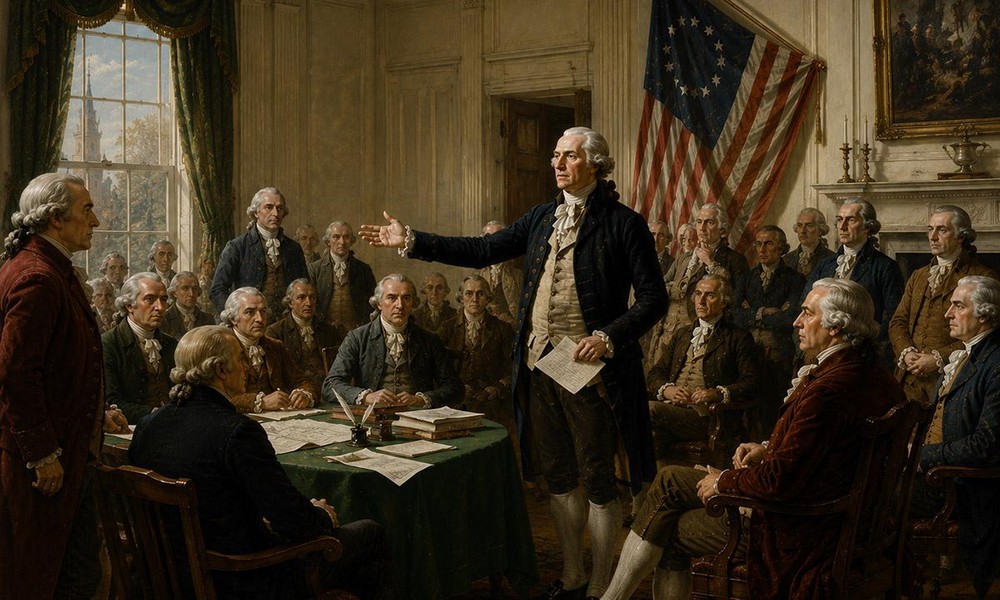

How revolutionary ideas about liberty, natural rights, and government helped inspire America’s fight for independence.
The American Revolution did not begin only on battlefields or in political assemblies. Long before the first musket fired at Lexington and Concord, a different type of revolution had already begun, one rooted in ideas. Across Europe during the 17th and 18th centuries, philosophers challenged long-standing beliefs about monarchy, authority, religion, freedom, and the rights of ordinary people. This intellectual movement became known as the Enlightenment, and its influence reached far beyond Europe, eventually shaping the arguments, goals, and ideals behind American independence.
When colonists protested British taxation, questioned royal authority, and demanded representation, they were not simply reacting emotionally to unfair treatment. Many were deeply influenced by Enlightenment thinking, which argued that governments existed to serve the people and protect individual rights, not control them without consent. These ideas helped transform frustration into a political movement powerful enough to reshape history.
The American Revolution became more than a conflict between colonies and an empire. It became one of the earliest large-scale attempts to apply Enlightenment principles to the creation of a new nation.
“The American Revolution was fought with muskets, but it was inspired by ideas.”
What Was the Enlightenment?
The Enlightenment was an intellectual movement that spread throughout Europe during the late 1600s and 1700s. Often called the “Age of Reason,” it emphasized logic, science, human rights, and skepticism toward absolute authority.
Before the Enlightenment, many societies accepted the belief that kings ruled through divine right, meaning their authority came directly from God and could not be questioned by ordinary citizens. Governments often exercised broad control, and citizens had limited political influence.
Enlightenment thinkers challenged these ideas. Philosophers began asking difficult questions: What gives governments power? What rights do people naturally possess? What happens when leaders abuse authority?
Instead of blindly accepting tradition, Enlightenment thinkers argued that reason and evidence should guide decisions. Human beings, they believed, were capable of creating better systems of government through rational thinking and shared principles.
Books, pamphlets, essays, and discussions helped spread these ideas across Europe and eventually into the American colonies, where educated colonists increasingly embraced new ways of thinking about power and freedom.
John Locke and the Idea of Natural Rights
Among the most influential Enlightenment philosophers was John Locke, whose ideas became foundational to the American independence movement.
Locke argued that all people were born with natural rights that governments could not take away. These included the rights to life, liberty, and property. According to Locke, governments existed for one primary reason: to protect these rights.
He also introduced the concept of the social contract. In this idea, citizens agreed to follow laws and support the government in exchange for protection and fairness. However, Locke believed that if a government violated the rights of its people or abused its power, citizens had the right to challenge or even replace it.
These beliefs deeply influenced colonial leaders.
Many colonists increasingly viewed British policies, including taxation without representation and restrictions on self-government, as violations of their rights. The idea that government power depended on the consent of the governed became central to revolutionary arguments.
Perhaps the clearest example appears in the Declaration of Independence, written primarily by Thomas Jefferson. Jefferson famously wrote that all men possess “unalienable Rights,” including “Life, Liberty and the pursuit of Happiness,” language that was strongly influenced by Locke’s philosophy.
The Declaration also echoes Locke’s belief that governments derive “their just powers from the consent of the governed” and that people may alter or abolish governments that become destructive.
Montesquieu and the Separation of Powers
Another major Enlightenment thinker who shaped American independence and future government systems was Montesquieu.
Montesquieu worried about governments becoming too powerful. He believed concentrated authority often led to corruption and tyranny.
To prevent abuse, he proposed separating government into different branches with distinct responsibilities. Instead of giving all power to one ruler or institution, he believed power should be divided so that each branch could limit the others.
This idea strongly influenced American political leaders during and after the Revolution.
Colonists feared recreating another form of unchecked monarchy after gaining independence. As a result, Montesquieu’s ideas later became essential to the structure of the United States government, particularly in the Constitution.
The executive, legislative, and judicial branches all reflect Enlightenment concerns about balancing power and protecting liberty.
Even today, checks and balances within modern democratic systems reflect the lasting influence of Montesquieu’s philosophy.
“The Revolution was not only about escaping British rule; it was about building a government designed to avoid tyranny.”
Enlightenment Ideas in Colonial Resistance
As tensions between Britain and the colonies increased during the 1760s and 1770s, Enlightenment thinking became increasingly visible in colonial protests and political arguments.
British taxes like the Stamp Act and Tea Act angered colonists not only because they cost money but also because they challenged Enlightenment ideas about representation and fairness.
Colonists increasingly believed that government should require the consent of the people it governed. Since the colonies lacked direct representation in Parliament, many viewed taxation as unjust.
Pamphlets, speeches, and newspapers helped spread these ideas quickly.
One especially influential work was the pamphlet Common Sense by Thomas Paine, published in 1776. Paine argued passionately that monarchy itself was irrational and harmful. He encouraged colonists to pursue independence and create a government based on republican ideals rather than hereditary rule.
Common Sense made complex Enlightenment philosophy understandable to ordinary colonists, helping turn growing frustration into widespread support for independence.
The Revolution therefore became both political and philosophical. Colonists increasingly believed they were defending universal principles of liberty, justice, and self-government.
The Contradictions of Enlightenment Ideals
Although Enlightenment ideas strongly influenced American independence, the Revolution also revealed major contradictions.
The Declaration of Independence declared equality and natural rights, yet slavery continued throughout much of the new nation. Women played essential roles during the Revolution but remained excluded from formal political participation.
Native American communities also experienced major consequences as expansion continued after independence.
These contradictions remind historians that while Enlightenment ideals inspired progress, their implementation remained incomplete.
Still, the Revolution created a framework that later reformers would continue using to argue for expanded rights and freedoms.
Abolitionists, women’s suffrage advocates, civil rights leaders, and democratic reform movements often pointed back to the same revolutionary principles rooted in Enlightenment philosophy.
The Revolution did not fully achieve equality, but it introduced ideas powerful enough to inspire generations of change.
Why Enlightenment Ideas Still Matter Today
The influence of Enlightenment thinking extends far beyond the American Revolution.
Modern democratic societies continue relying on ideas first popularized during the Enlightenment, including constitutional government, free speech, individual rights, representative government, religious freedom, and limits on political power.
The belief that leaders should remain accountable to citizens remains central to democratic systems worldwide.
Many debates surrounding government authority, civil liberties, voting rights, and political representation still reflect Enlightenment questions asked centuries ago.
The Revolution demonstrated that ideas could reshape nations. Colonists transformed philosophical theories into political action, creating one of history’s most influential democratic experiments.
Understanding the Enlightenment helps explain not only why the American Revolution happened, but also why its legacy continues shaping political discussions today.
FAQs
What was the Enlightenment?
The Enlightenment was an intellectual movement emphasizing reason, individual rights, science, and limited government.
Who influenced American independence the most?
Philosophers like John Locke, Montesquieu, and later Thomas Paine strongly influenced revolutionary thinking.
How did Enlightenment ideas affect the Declaration of Independence?
The Declaration reflected ideas about natural rights, government by consent, and the right to resist tyranny.
Why were Enlightenment ideas important?
They helped colonists justify independence and later influenced democratic government systems.
Conclusion
The American Revolution was shaped by far more than military victories or political disagreements. At its core, it was a revolution of ideas. Enlightenment thinkers challenged old assumptions about monarchy and power while introducing new beliefs about liberty, equality, and government responsibility.
Colonists embraced these ideas and transformed them into action, creating a movement that would reshape global history. Although the Revolution did not fully achieve every ideal it promoted, it established principles that continue influencing democratic societies centuries later.
Understanding the influence of Enlightenment philosophy helps reveal why the fight for American independence became one of the most important turning points in modern history.